

Executive summary
- The Fed unanimously voted to raise the Fed Funds policy rate by 25 bps to 3.75% – 4.00% p.a. The immediate market reaction was more hawkish and risk-off than expected: US equities fell, the US 10-year treasury yield moved back to 5% p.a. and the US dollar appreciated.
- The key concern was not the anticipated hike itself, but the prospect of further rate hikes. This could raise the cost of liquidity and capital for investors.
- The Fed made no significant changes to its macroeconomic outlook. US economic growth is fundamentally sound and unemployment is low. As such, the economy is in a strong enough position to navigate tighter monetary conditions.
- Investors may now have to face the prospect of policy rates remaining higher for longer, with no immediate cuts expected soon. But with the Fed’s own assessment that inflation is expected to fall towards around 2.5% in 2027, this may not spark the beginning of a sustained rate hiking cycle. The Fed just needs to show that it has or is willing to do enough to lead market expectations.
- The BoJ is expected to raise its policy rate from 1.00% to 1.25% on 18 September, reflecting a different policy-normalisation path from the US.
- In terms of forward direction, Fullerton is cautious over the short term (there could be heightened volatility), but we maintain a positive 12-month outlook for risk assets and see the potential for a “soft landing” in investment returns ahead.
A potential “double banger” – what’s going on?
The Fed
As became widely expected, over the last week or so by investors and financial markets, the Fed voted unanimously (12-0) to hike rates by 25 bps taking the Fed Funds policy rate range to: 3.75% to 4% p.a.1
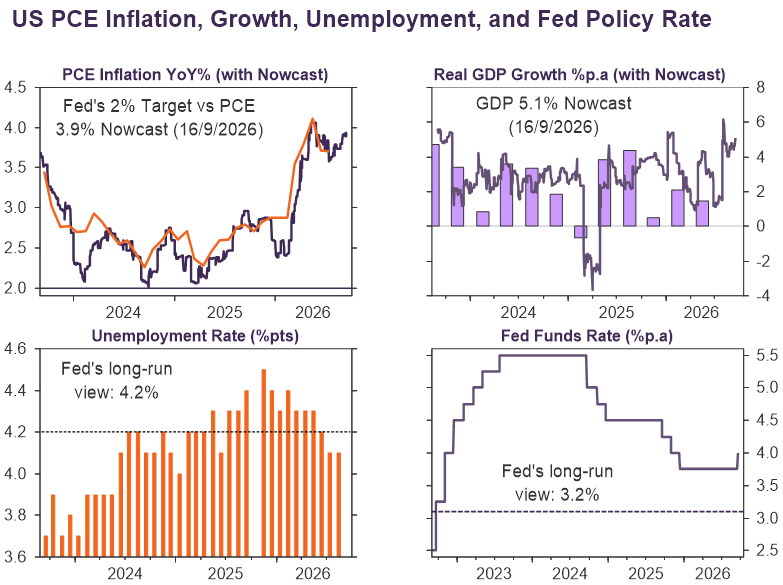
The Fed not hiking until now in 2026 does not appear to be because of any fear about possible adverse impacts on US growth or equity market performance as they are fundamentally strong, and unemployment is very low. The Fed being on hold, and they were not alone globally in that action2, reflected the belief that hiking into an oil shock driven by a war, is the wrong policy response when your policy rate is already above neutral, and while services inflation remains stable, and (bond market) inflation expectations low.
That is all on the “backburner” for now as the Fed has hit the “reset” button to try and catch-up to market expectations, and lead the policy narrative. Timing wise, for the US economy to endure rate hikes, it could not be better as growth is very strong and unemployment low. A common argument was that the Fed needed to deliver a 25bp hike – not because of much higher inflation than expected, but because holding rates would have resulted in a significant negative reaction across financial markets.
Regardless, markets suffered on the day – “risk-off” moves unfolded as US equities fell, the US 10y bond yield increased (back to 5% p.a.3), and the US dollar appreciated. It will take time for the market to consider all the dynamics, but the initial reaction proved more hawkish and risk-off than expected as the market reacted badly to the prospect of further Fed rate hikes ahead.
The BoJ- setting the stage
The Bank of Japan (BoJ) is also expected to hike its policy rate on Friday 18 Sep4, but Japan has a very different environment than the US as the BoJ policy rate is below what they regard as their neutral policy rate5 and Japan’s CPI inflation is low at the BoJ’s 2% p.a. target6. If realised tomorrow, the rate hike by the BoJ from 1% to 1.25%, its second hike this year, reflects its journey back up to its neutral policy rate. A BoJ rate hike may help ease upward pressure on the JGB 10y yield and depreciation pressure on the yen – especially if the BoJ gives forward signals that it is still hiking back toward normality.
Implications
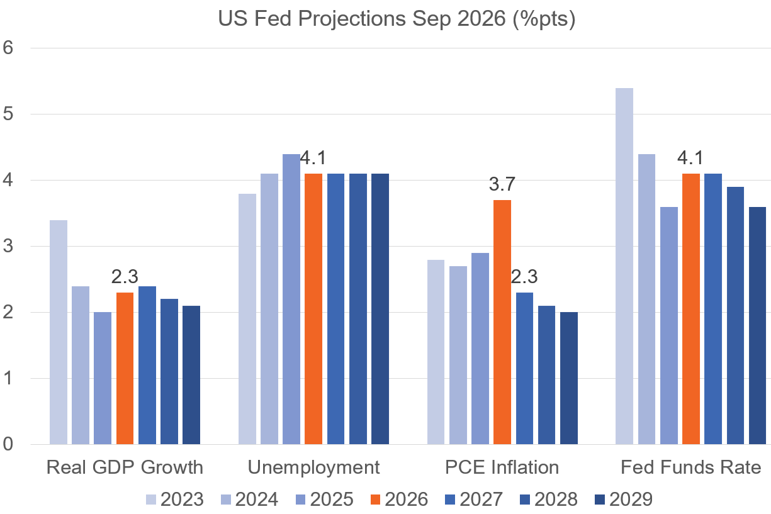
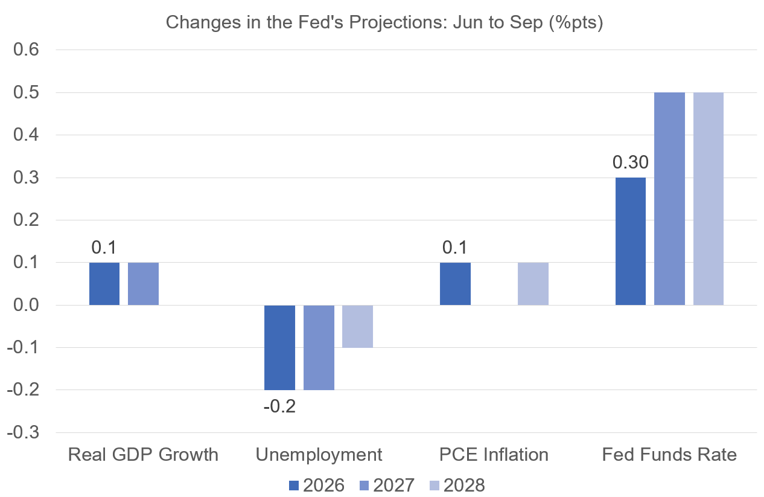
As per usual, the Fed also presented its Economic Projections out to 20297, and its policy rate “dot plot” (but Chairman Kevin Warsh does not participate in the dot plot). The Fed made no significant changes to its macro outlook assumptions (i.e. growth, inflation, and unemployment – see Figures 3 and 4), but investors now face the prospect of a high policy rate for longer with no rate cuts anytime soon.
But given the Fed’s positive outlook on US fundamentals (see Figure 3), and that inflation is expected to fall back significantly next year (Figures 3 and 5), this may not spark the beginning of a sustained rate hiking cycle. The Fed may only need to hike enough until it has got back to a position to lead market expectations.
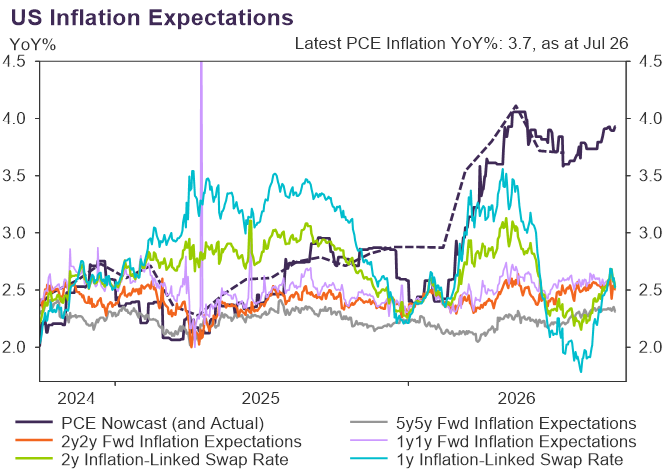
Key takeaways from the Fed projections are that PCE inflation is believed to have peaked from the surge in oil prices, at sub 4% p.a. for 2026, but the disinflation to come will take time and won’t unfold in a straight-line (see Figure 3). The Fed, the Consensus, and the US bond market, all expect US inflation to be much lower in 2027 at around 2.5% p.a. (see Figure 5). How “tight” Fed policy may be is not just about the hike decision but also how far the interest rate may be above what most regard as the “normal” or neutral interest rate. For the Fed they assume that policy rate is 3.2% p.a.8. So US Fed policy is quite tight, as needed to bring PCE inflation back down over time toward the Fed’s 2% p.a. target.
The important drivers of disinflation ahead remain low inflation expectations, stable services inflation, investment boosting capacity, and with productivity gains lowering real unit costs of production. It will take time for the market to consider all the implications, but the initial reaction proved more hawkish and risk-off than expected as the market reacted adversely to the prospect of further Fed rate hikes.
This will raise the cost of liquidity and capital for investing, and could prove an additional headwind for investors to navigate. Behaviour so far is consistent with tighter financial conditions rather than a classic growth or earnings scare. The immediate trigger was not the widely expected 25 bps hike itself, but rather Chairman Kevin Warsh’s emphasis that inflation remains too high (which is not news), together with the market’s interpretation that another hike (at least) may be required.
Fullerton is cautious on the investment outlook over the short-term – volatility could remain significant, especially for the next few months. Fullerton maintains its positive outlook for risk asset returns over the next 12 months, as presented in our August FIV, because this rate hike by the Fed is as the market expected, and most importantly we believe that the US economy is fundamentally strong enough to navigate tighter monetary conditions. We remain confident on the prospect of a “soft-landing” unfolding for investment returns9.
Figure 1: How the US forward (policy rate) market reacted – US policy rates expected by the market are still 4.5% by end 2027 versus the Fed’s assumed 4.1% p.a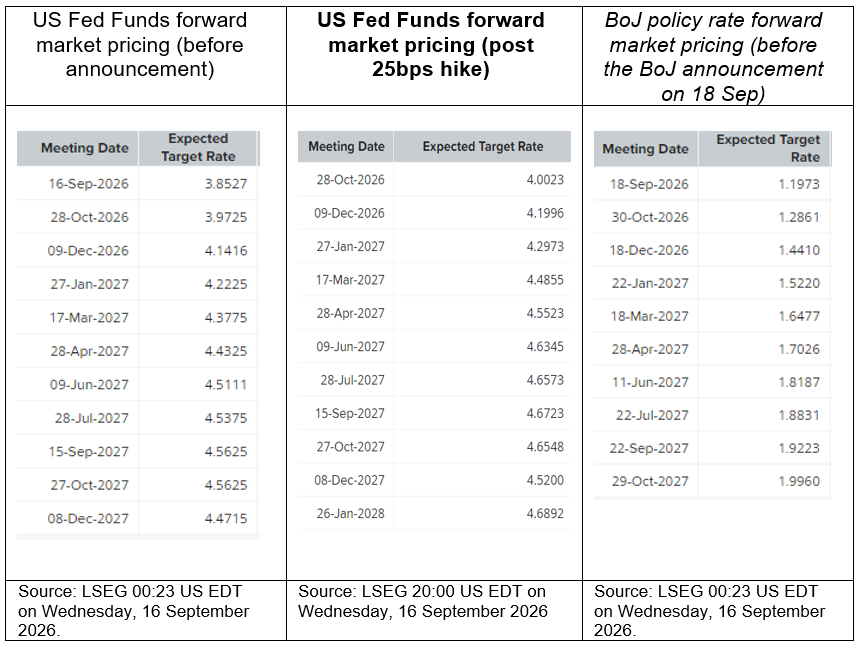
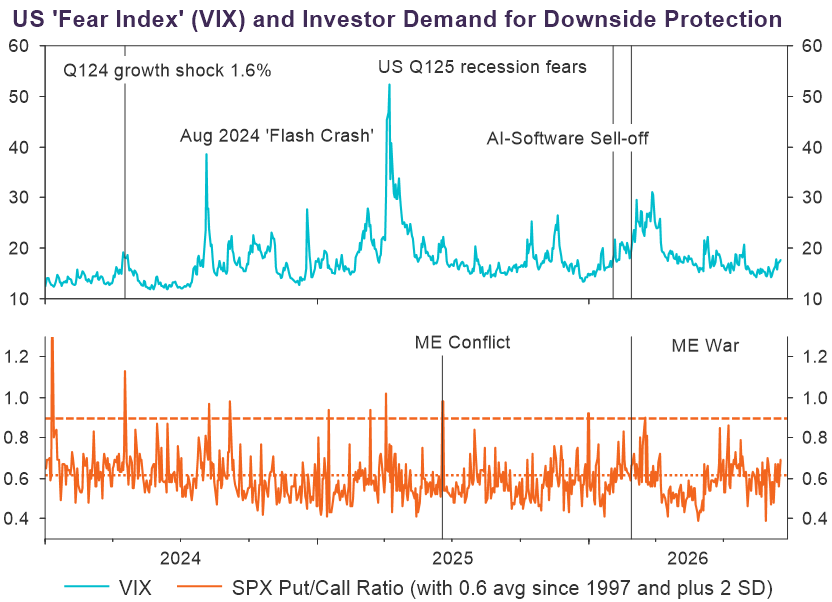
Figure 2: The VIX ‘Fear Index’ (top panel) is still low but US investors’ demand for downside protection is too low and likely to rise
Source: LSEG Datastream, 17 Sep 2026.
Figure 3: Fed Projections: the ‘big call’ remains the large fall in inflation next year
Source: US Fed Summary of Economic Projections, September 16, 2026.
Figure 4: Fed Projections: no material changes from June except higher rates for longer
Source: US Fed Summary of Economic Projections, September 16, 2026.
Figure 5: The US bond market agrees with the Fed projections: US inflation can be 2.5% p.a. in 2027
Source: LSEG Datastream, 17 Sep 2026.
Figure 6: US Exceptionalism – Optimists would judge it is the best time for the Fed to hike because US growth is extremely strong and unemployment low
Source: LSEG Datastream, 17 Sep 2026.
1 Source: Federal Reserve Board – Implementation Note issued September 16, 2026.
2 See Fullerton Investment Views Q3 2026.
3 Source: LSEG Datastream, as of 17 September.
4 Source: as extrapolated from the BoJ policy rate forward market pricing data, LSEG Datastream, 16 September 2026.
5 Source: The Bank of Japan Review, March 2026 “Developments in the Natural Rate of Interest”. The forward market believes the BoJ will reach a 1.75% policy rate by 11 June 2027 (see Figure 1).
6 Source: Statistics Bureau, Ministry of Internal Affairs & Communication, Japan – CPI inflation 1.9% YoY July.
7,8 Source: Summary of Economic Projections, September 16, 2026.
9 See Fullerton Investment Views Q3 2026
Important Information
No offer or invitation is considered to be made if such offer is not authorised or permitted. This is not the basis for any contract to deal in any security or instrument, or for Fullerton Fund Management Company Ltd (UEN: 200312672W) (“Fullerton”) or its affiliates to enter into or arrange any type of transaction. Any investments made are not obligations of, deposits in, or guaranteed by Fullerton. The contents herein may be amended without notice. Fullerton, its affiliates and their directors and employees, do not accept any liability from the use of this publication. The information contained herein has been obtained from sources believed to be reliable but has not been independently verified, although Fullerton Fund Management Company Ltd. (UEN: 200312672W) (“Fullerton”) believes it to be fair and not misleading. Such information is solely indicative and may be subject to modification from time to time.
The audio(s) have been generated by an AI app