With the volatile intertest rate and yield backdrop, some investors may be wondering what comes next.
One option to consider are Asian bond funds.
Broadly, these funds provide investors exposure to a diversified basket of bonds issued by governments, government agencies and corporates across Asia.
For investors, they can offer an avenue to potentially earn income while diversifying beyond other asset classes.
Here is a simple look at how Asian bond funds could potentially fit into your portfolio.
Why Asian bonds, and why now?
When interest rates fall, bond prices typically tend to rise. This means bonds purchased when yields were higher (before a rate easing cycle) can possibly provide income, with the potential for capital gains as well. As it is, we do not expect USD rates to come off materially for the rest of 2026 – the Fed is likely to hold for the rest of 2026 with policy actions further out, remaining data-dependent and influenced by developments in the Middle East conflict *.
*(Note: views are as of May 2026, and subject to change without prior notice).
Moreover, Asia has a wide range of bond issuers across markets such as Singapore, Japan, Australia, China and Indonesia. Additionally, supply headwinds in the Asian Credit space at this juncture is less pronounced versus Developed Market USD credits for example – where the latter is seeing a strong supply pipeline from US tech-related issuers.
Several ways to invest, depending on your risk appetite
Not all Asian bond funds are built the same.
Fullerton offers a range of bond funds for different investor needs, from more conservative options to higher-income strategies.
For investors who are comfortable with the risks of a fund that invests in short duration fixed income or debt securities, Fullerton Lux Funds – Asian Short Duration Bonds holds a diversified portfolio of USD-denominated Asian bonds, with calibrated exposure to the high yield sector (up to 30% depending on the market opportunities and manager discretion), with an average duration of 2.4 years (as of 30 April 2026). It also generated a 1-year return of 5.67% in USD terms on a bid-to-bis basis (as of 30 April 2026).
Fullerton Lux Funds – Asian Short Duration Bonds – Class A (USD) Acc
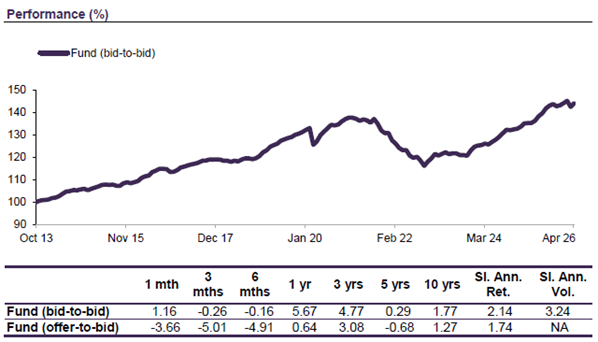
Returns of more than 1 year are annualised. Returns are calculated on a single pricing basis in USD with net dividends and distributions (if any) reinvested. Offer-to-bid returns include an assumed preliminary charge of 5% which may or may not be charged to investors. Past performance is not indicative of future returns. Source: Fullerton Fund Management Company Ltd, data as of 30 April 2026.
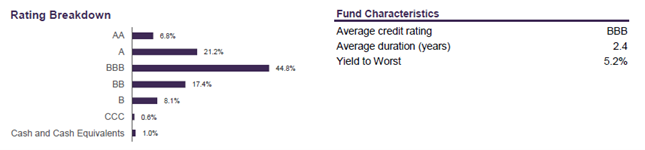
Source: Fullerton Fund Management Company Ltd, data as of 30 April 2026.
For investors willing to assume incremental duration risk and who are comfortable with the risks of a fund that invests in fixed income or debt securities denominated primarily in USD, there is Fullerton Lux Funds – Asian Investment Grade Bonds that focuses on investment grade Asian bonds with an average credit rating of A and a yield to worst of 5.0% as of 30 April 2026.
Fullerton Lux Funds – Asian Investment Grade Bonds – Class I (SGD Hedged) Acc
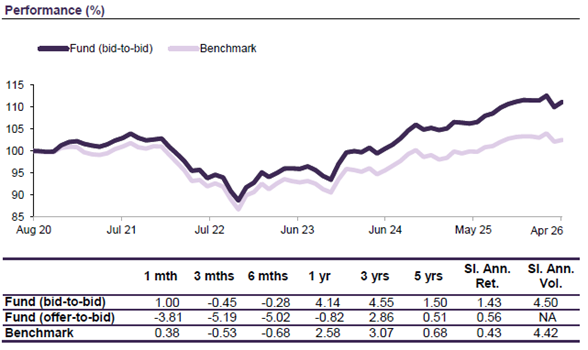
Returns of more than 1 year are annualised. Returns are calculated on a single pricing basis in SGD with net dividends and distributions (if any) reinvested. Offer-to-bid returns include an assumed preliminary charge of 5% which may or may not be charged to investors. Past performance is not indicative of future returns. Benchmark: JACI Investment Grade Total Return – SGD Hedged Index. Source: Fullerton Fund Management Company Ltd, J.P. Morgan Securities LLC and Bloomberg. Data as of 30 April 2026.
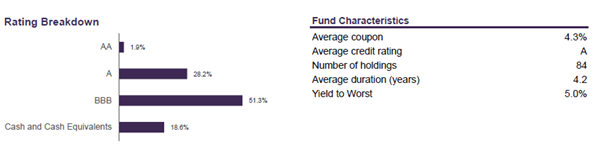
Source: Fullerton Fund Management Company Ltd, data as of 30 April 2026.
How do these funds fit into a portfolio?
One way to possibly think of Asian bond funds is akin to that of a middle layer between cash (lower risk, lower return) and equities (higher risk, higher potential return).
They can help to generate regular income as cash yields fall, provide potential stability when equity markets are volatile, and help to diversify one’s exposure across countries and sectors in Asia’s dynamic bond market.
In a balanced portfolio, they could also help to possibly smoothen overall returns while still contributing to overall income and growth.
Risks to watch out for1
Bond funds are not capital guaranteed, and their value can fall. Rising interest rates, credit events, or unfavourable currency movements can adversely affect return outcomes.
This is where actively managed fixed income funds can be helpful – as they offer the flexibility to adjust the underlying portfolio’s positions accordingly to the market cycle and be appropriately positioned amid shifting market conditions – although there is the risk that managers could also be wrongfooted by the market cycle.
The bottom line
As the interest rate cycle evolve, Asian bond funds can potentially offer an avenue to stay invested, generate income, and manage risk proactively within a diversified portfolio.
Explore Fullerton’s wider range of fixed income solutions at: https://www.fullertonfund.com/investment-capabilities/fixed-income/
1 Please refer to the Fund’s prospectus for key risks of each Fund mentioned in the article.
Important Information:
This publication is for information only and your specific investment objectives, financial situation and needs are not considered here. The value of units in the Fund and any accruing income from the units may fall or rise. Any past performance, prediction or forecast is not indicative of future or likely performance. Any past payout yields and payments are not indicative of future payout yields and payments. Distributions (if any) may be declared at the absolute discretion of Fullerton Fund Management Company Ltd (UEN: 200312672W) (“Fullerton”) and are not guaranteed. Distribution may be declared out of income and/or capital of the Fund, in accordance with the prospectus. Where distributions (if any) are declared in accordance with the prospectus, this may result in an immediate reduction of the net asset value per unit in the Fund. Applications must be made on the application form accompanying the prospectus, which can be obtained from Fullerton or its approved distributors. You should read the prospectus and seek advice from a financial adviser before investing. If you choose not to seek advice, you should consider whether the Fund is suitable for you. The Fund may use or invest in financial derivative instruments. Please refer to the prospectus of the Fund for more information.
This advertisement or publication has not been reviewed by the Monetary Authority of Singapore.
Please refer to https://www.fullertonfund.com/use-of-third-party-data-information/ for disclaimers on use of data from third parties.