
Year-end reminder: have you contributed to your SRS?
With the year drawing to a close, investors may want to review whether they have made use of their Supplementary Retirement Scheme (SRS) contribution limit for 2026.
SRS contributions made by 31 December 2026, subject to the SRS operator’s cut-off time, can qualify for tax relief in the following Year of Assessment, provided the relevant conditions are met1.
For Singapore Citizens and Permanent Residents, the annual SRS contribution cap is S$15,300, while foreigners can contribute up to S$35,700 a year1.
The total amount of personal income tax reliefs claimed is also subject to an overall cap of S$80,000 for each Year of Assessment1.
But making an SRS contribution is only the first step. For investors with many years before retirement, how the money is subsequently invested can also have a meaningful impact on their longer-term retirement savings.
Investing with your SRS
SRS was introduced to encourage individuals to save for retirement on top of their CPF savings. Contributions can qualify for tax relief, while investment returns are not taxed before withdrawal.
For qualifying withdrawals made at or after the prescribed retirement age, (i.e. the statutory retirement age prevailing when the first SRS contribution was made), only 50% of the amount withdrawn is subject to tax.
That makes SRS a long-term retirement savings vehicle, but after making a contribution, there is another decision to consider: what should you do with the money in the account?
This question is worth considering as uninvested balances only earn a nominal rate of return.
For investors with a longer time horizon, investing some of their SRS savings may provide greater potential for long-term growth, depending on their objectives and risk tolerance.
Fullerton offers SRS-eligible strategies across short-duration fixed income, income-oriented bonds and Singapore equities, providing different ways to invest according to an investor’s time horizon, return objectives, and risk appetite.
Three ways to put your SRS to work with Fullerton
For potential stability: Fullerton Short Term Interest Rate Fund
For investors who seek medium term capital appreciation and relative stability, the Fullerton Short Term Interest Rate Fund offers a more conservative approach to investing their SRS savings, although its value can still fluctuate.
The fund invests primarily in shorter duration fixed income securities, with underlying securities having a maturity limit of five years.
Foreign currency-denominated bonds are also fully hedged back to SGD, except for a 5% frictional currency limit.
Figure 1: Fullerton Short Term Interest Rate Fund allocation, fund profile, and holdings
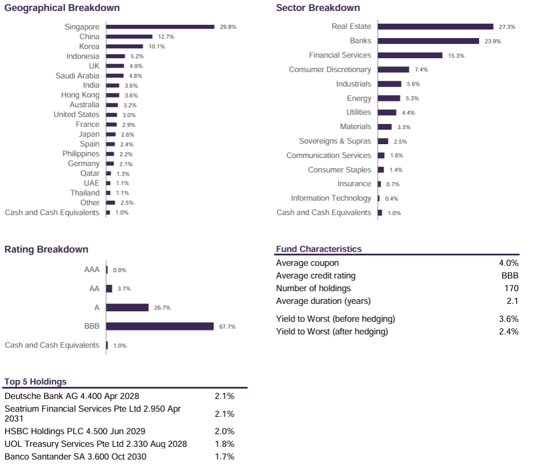
Source: Fullerton Short Term Interest Rate – Class C (SGD) factsheet, 31 August 2026.
As of 31 August 2026, the fund had an average duration of around two years. Duration is a measure of how sensitive a bond portfolio is to changes in interest rates, so a shorter duration profile generally means lower sensitivity than a longer-duration bond strategy to interest rate fluctuations.
This may be a useful consideration for investors who want to keep part of their SRS portfolio in relatively lower-volatility assets, particularly as they move closer to their intended withdrawal horizon.
For investors who do not want their SRS savings to remain entirely in cash, and are willing to take some risk, short-duration fixed income can therefore provide a more conservative option2 to put part of their money to work.
Over the one year to 31 August 2026, the Fullerton Short Term Interest Rate Fund – Class C (SGD) share class returned 1.01% on a bid-to-bid basis.
Figure 2: Fullerton Short Term Interest Rate Fund performance
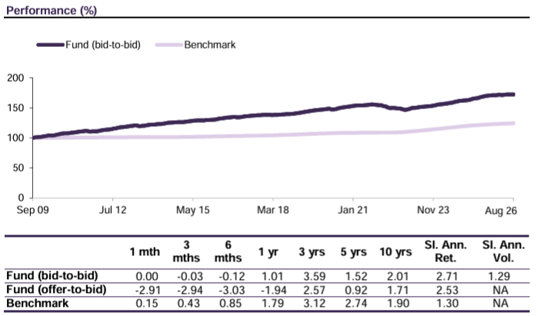
Source: Fullerton Short Term Interest Rate – Class C (SGD) factsheet, 31 August 2026. Returns of more than 1 year are annualised. Returns are calculated on a single pricing basis in SGD with net dividends and distributions (if any) reinvested. Offer-to-bid returns include an assumed preliminary charge of 3% which may or may not be charged to investors. Benchmark: 3M SORA + 0.60% p.a. With effect from 1 August 2023, the benchmark is 3M SORA + 0.60% p.a. From inception till 31 July 2023, the benchmark was 3M SIBID.
For potential income: Fullerton SGD Income Fund
For investors seeking long-term capital appreciation and / or income, and a broader SGD fixed income allocation, the Fullerton SGD Income Fund offers another possible avenue to invests their SRS savings.
This fund invests in a diversified portfolio of primarily investment-grade fixed income securities. It can invest in both SGD and foreign currency-denominated bonds, with foreign currency exposure fully hedged back to SGD, subject to a 5% frictional currency limit.
The fund may also invest up to 30% of its NAV in non-investment-grade bonds.
Compared with the Fullerton Short Term Interest Rate Fund, the SGD Income Fund has a broader fixed income opportunity set and a longer duration profile. As of 31 August 2026, its average duration was around 4.4 years, compared with around two years for the Fullerton Short Term Interest Rate Fund.
Figure 3: Fullerton SGD Income Fund allocation, fund profile, and holdings
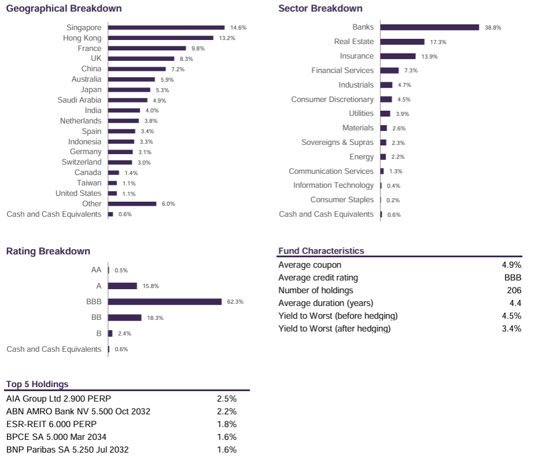
Source: Fullerton SGD Income Fund – Class A factsheet, 31 August 2026.
The longer duration profile and additional credit exposure for Fullerton SGD Income Fund means the fund may be more sensitive to movements in interest rates and credit markets, and may therefore experience somewhat higher volatility, although the broader opportunity set may offer higher income potential than a shorter-duration strategy.
This positions the fund between shorter-duration fixed income and equities within the three approaches discussed in this article, and provides options for investors seeking income while accepting greater fluctuations in portfolio value3.
Over the one year to 31 August 2026, Class A (SGD) returned 1.60% on a bid-to-bid basis.
Figure 4: Fullerton SGD Income Fund performance
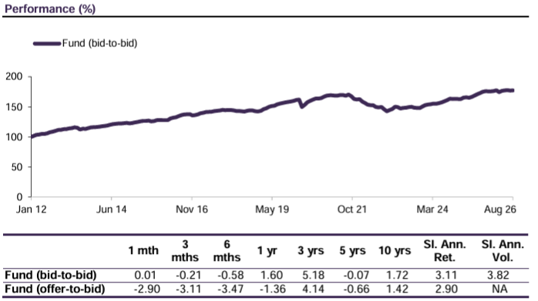
Source: Fullerton SGD Income Fund – Class A factsheet, 31 August 2026. Returns of more than 1 year are annualised. Returns are calculated on a single pricing basis in SGD with net dividends and distributions (if any) reinvested. Offer-to-bid returns include an assumed preliminary charge of 3% which may or may not be charged to investors.
For potentially longer-term growth: Fullerton Singapore Value-Up
For investors with many years ahead before their intended SRS withdrawals, and who can tolerate greater short-term volatility, Fullerton Singapore Value-Up Fund provides exposure to Singapore equities for potentially long-term capital growth.
The fund invests primarily in equities and equity-related securities listed on the Singapore Exchange, with a focus on companies across all market capitalisation structures, where positive corporate changes may help unlock shareholder value over time.
Its investment universe can include REITs, IPOs and pre-IPOs. The fund also targets an allocation of around 30% of NAV to small- and/or mid-cap Singapore equities, although this may vary depending on liquidity and market conditions.
This gives the fund a different role from the two fixed income strategies. Rather than focusing primarily on stability or income, it seeks long-term capital appreciation through Singapore equities.
As with equity investments generally, this comes with greater potential for short-term price fluctuations.
Equity markets can experience significant declines during periods of market stress, so investors need to be comfortable with fluctuations in portfolio value4 and have an appropriately longer-term investment horizon.
The fund is available in both distributing and accumulating share classes. In a distributing class, any distributions declared by the fund are paid into the investor’s SRS account. In an accumulating class, income remains within the fund rather than being paid out and this is reflected in the value of the units. Distributions are not guaranteed, may vary from time to time, and are at the manager’s discretion5 .
As of 31 August 2026, the fund’s largest sector exposures were Financials, Industrials and Real Estate, while its largest holdings included DBS Group Holdings, Oversea-Chinese Banking Corporation and United Overseas Bank.
From its inception on 2 October 2025 to 31 August 2026, Class A (SGD) Acc returned 31.11% on a bid-to-bid basis.
Figure 5: Fullerton Singapore Value-Up allocation, holdings, and performance
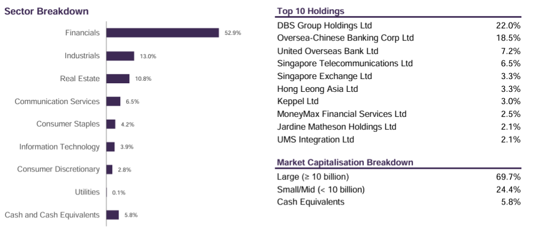
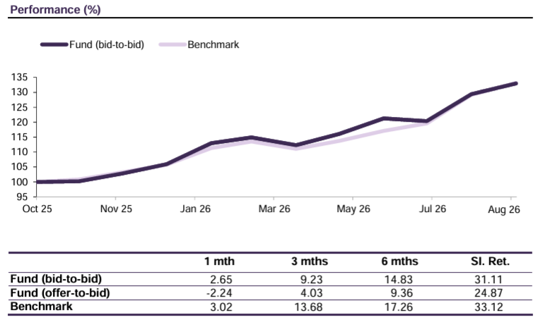
Source (both charts): Fullerton Singapore Value-Up – Class A (SGD) Acc factsheet, 31 August 2026. Returns of more than 1 year are annualised. Returns are calculated on a single pricing basis in SGD with net dividends and distributions (if any) reinvested. Offer-to-bid returns include an assumed preliminary charge of 5% which may or may not be charged to investors. Benchmark: FTSE Straits Times All Share Total Return Index.
Match your SRS investments to your retirement timeline
The longer-term nature of SRS means the investment approach does not necessarily have to remain the same throughout an investor’s working life.
Investors with many years before their intended withdrawals may have more time to ride out short-term market fluctuations and may therefore have a greater capacity to take on growth exposure.
As retirement approaches, the focus may gradually shift towards income generation and stability, particularly as there is less time to recover from significant market declines.
There is no single allocation that suits everyone. The appropriate mix will depend on factors such as an individual’s objectives, financial circumstances, investment horizon and risk tolerance.
What matters is that the investments within an SRS account continue to reflect the eventual purpose of the savings, rather than being passively left unchanged as an investor’s needs and circumstances evolve.
Bottom line
The year-end SRS decision has two parts: whether to contribute, and how to invest the contribution.
The potential tax relief can provide an immediate benefit, but SRS is designed for long-term retirement savings. Over time, the way those savings are invested may have an important impact on the value of the account.
Fullerton’s SRS-eligible strategies provide choices and different avenues to approach that decision across stability, income and growth considerations. The Fullerton Short Term Interest Rate Fund offers shorter-duration fixed income exposure, the Fullerton SGD Income Fund provides a broader income-oriented bond allocation, while Fullerton Singapore Value-Up Fund provides exposure to Singapore equities for potentially long-term capital appreciation.
The appropriate approach ultimately depends on an investor’s objectives, risk tolerance, and time to their intended SRS withdrawals.
Explore Fullerton’s wider investment solutions at: https://www.fullertonfund.com/investment-funds/featured-funds/
2,3,4 Please refer to respective fund prospectus for key risks of the Fund.
5 Distribution may be declared out of income and/or capital of the Fund, in accordance with the prospectus. Where distributions (if any) are declared in accordance with the prospectus, this may result in an immediate reduction of the net asset value per unit in the Fund.
Publication date: October 2026.
Important Information:
This publication is for information only and your specific investment objectives, financial situation and needs are not considered here. The value of units in the Fund and any accruing income from the units may fall or rise. Any past performance, prediction or forecast is not indicative of future or likely performance. Any past payout yields and payments are not indicative of future payout yields and payments. Distributions (if any) may be declared at the absolute discretion of Fullerton Fund Management Company Ltd (UEN: 200312672W) (“Fullerton”) and are not guaranteed.
Distribution may be declared out of income and/or capital of the Fund, in accordance with the prospectus. Where distributions (if any) are declared in accordance with the prospectus, this may result in an immediate reduction of the net asset value per unit in the Fund. Applications must be made on the application form accompanying the prospectus, which can be obtained from Fullerton or its approved distributors. You should read the prospectus and seek advice from a financial adviser before investing. If you choose not to seek advice, you should consider whether the Fund is suitable for you. The Fund may use or invest in financial derivative instruments. Please refer to the prospectus of the Fund for more information.
This advertisement or publication has not been reviewed by the Monetary Authority of Singapore.