Bond markets are facing a less straightforward path on the interest rate outlook, making portfolio positioning more important than a simple call on whether rates next move up or down.
After the US Federal Reserve cut rates in late 2025 where cash and T-bill yields drifted lower, bond funds regained attention as investors looked to lock in income and diversify away from cash.
More recently, renewed inflation pressures, oil-related risks and shifting market pricing have made the near-term outlook less clear cut.
While markets have started to price in some chance of further tightening, the broader picture remains more balanced: near-term rate volatility may stay elevated, but yields could still ease over a 12-month horizon if inflation pressures moderate or growth weakens.
Regardless, bond funds play a crucial role in a wider portfolio across market cycles, but investors may need to pay closer attention to duration risk, credit quality and how a fund is positioned for a more uncertain rate environment.
Why the rate outlook matters for bonds
When interest rates rise, bond prices tend to fall, especially for longer-duration bonds that are more sensitive to rate changes.
The key is duration, which measures how much a bond fund may move when interest rates change.
In an environment where rate hikes are possible, shorter-duration strategies may offer a more stable proposition, while investors seeking higher income should be prepared to assume higher risk.
To cater to various investors’ needs, Fullerton offers a range of actively managed bond funds, so investors may choose an approach that better fits their preferences and risk tolerance.
Five bond funds to consider, depending on your risk appetite
Not all bond funds are the same.
The examples below demonstrate how five Fullerton bond funds are positioned across the risk spectrum, from shorter-duration strategies to funds with greater exposure to Asian currencies or higher-yielding credits.
Selected Fullerton fixed income product offerings
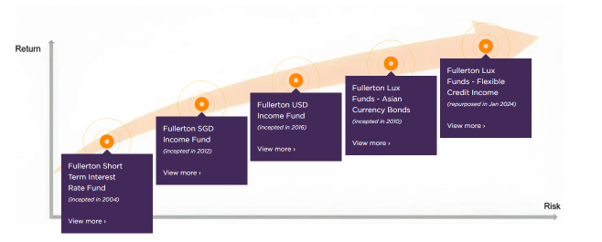
For illustrative purposes. Please refer to the respective Fund’s prospectus for more information.
#1 – Fullerton Short Term Interest Rate Fund
With an average duration of 2.0 years, yield to worst1 of 2.3% after hedging, and one-year return of 3.43%* for Class A SGD as of April 2026, the fund sits at the more conservative end of the bond fund spectrum.
*Calculated on a bid-bid single pricing basis in SGD with net dividends and distributions (if any) reinvested.
Its shorter duration profile means it is generally less sensitive to interest rate movements compared with longer-duration bond funds, although its value can still fluctuate.
Fullerton Short Term Interest Rate – Class A (SGD)
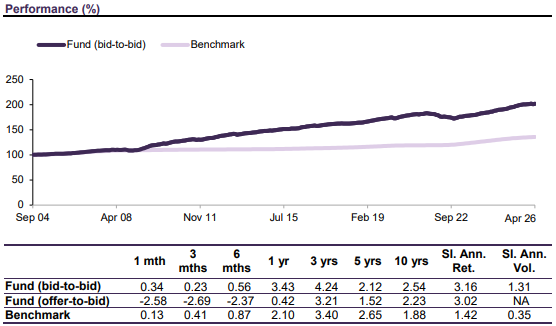
Returns of more than 1 year are annualised. Returns are calculated on a single pricing basis in SGD with net dividends and distributions (if any) reinvested. Offer-to-bid returns include an assumed preliminary charge of 3% which may or may not be charged to investors. Benchmark: 3M SORA + 0.60% p.a. Source: Fullerton Fund Management Company Ltd and Bloomberg, data as of 30 April 2026.
#2 – Fullerton SGD Income Fund
The Fullerton SGD Income Fund focuses on SGD income through a diversified portfolio of mostly investment-grade bonds, with the flexibility to invest in the high yield sector up to 30%.
It invests in SGD denominated bonds as well as foreign currency bonds that are fully hedged back to SGD . As of April 2026, the fund had an average duration of 4.4 years.
The fund returned 5.99%* over one year for the Class A SGD share class as of April 2026.
*Calculated on a bid-bid single pricing basis in SGD with net dividends and distributions (if any) reinvested.
Fullerton SGD Income Fund – Class A
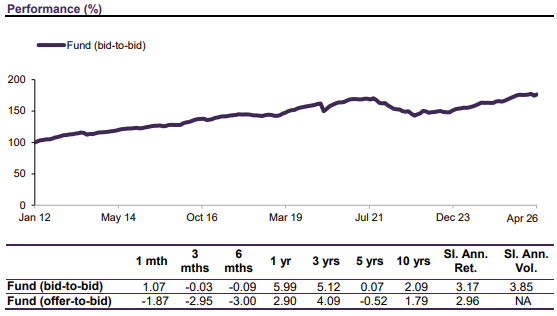
Returns of more than 1 year are annualised. Returns are calculated on a single pricing basis in SGD with net dividends and distributions (if any) reinvested. Offer-to-bid returns include an assumed preliminary charge of 3% which may or may not be charged to investors. Distributions are not guaranteed. Source: Fullerton Fund Management Company Ltd, data as of 30 April 2026.
#3 – Fullerton USD Income Fund (SGD Hedged)
The Fullerton USD Income Fund (SGD Hedged) invests mainly in USD-denominated investment-grade names, with the flexibility to hold up to 30% in non-investment-grade bonds.
As of April 2026, the fund had a yield to worst3 of 5.3%, average duration of 4.7 years, and one-year return of 6.92%* for the Class A SGD Hedged share class.
*Calculated on a bid-bid single pricing basis in SGD with net dividends and distributions (if any) reinvested.
Compared with a pure investment-grade bond fund, the fund’s allocation to non-investment-grade names may increase income potential, but this also introduces higher credit risk.
Fullerton USD Income Fund – Class A (SGD Hedged)
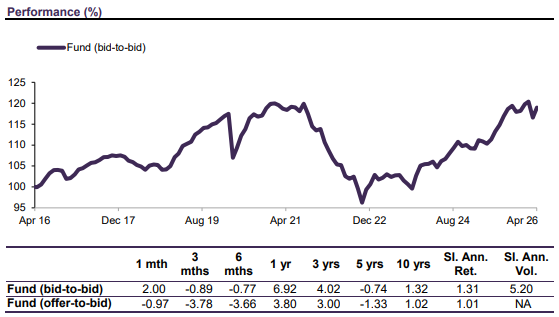
Returns of more than 1 year are annualised. Returns are calculated on a single pricing basis in SGD with net dividends and distributions (if any) reinvested. Offer-to-bid returns include an assumed preliminary charge of 3% which may or may not be charged to investors. Distributions are not guaranteed. Source: Fullerton Fund Management Company Ltd, data as of 30 April 2026.
#4 – Fullerton Lux Funds – Asian Currency Bonds
The Fullerton Lux Funds – Asian Currency Bonds provides exposure to fixed income securities denominated mainly in Asian currencies, across markets such as China, Korea, Malaysia, Singapore and Indonesia.
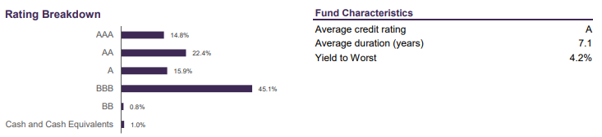
As of April 2026, the fund had an average credit rating of A, average duration of 7.1 years and yield to worst4 of 4.2%.
Because the fund invests in Asian local currency bonds, returns may be influenced not only by bond market movements, but also by currency fluctuations. This makes it more volatile than bond funds that are fully hedged back to SGD.
Fullerton Lux Funds – Asian Currency Bonds – Class A (SGD) Dist
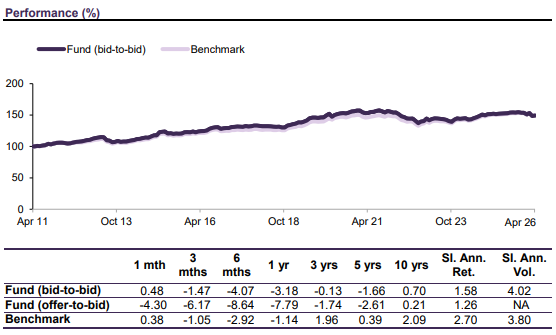
Returns of more than 1 year are annualised.Returns are calculated on a single pricing basis in SGD with net dividends and distributions (if any) reinvested. Offer-to-bid returns include an assumed preliminary charge of 5% which may or may not be charged to investors. Past performance is not indicative of future returns. Benchmark: Markit iBoxx ALBI (USD Unhedged) Index With effect from 1 May 2016, the benchmark has been changed to Markit iBoxx ALBI (USD Unhedged) Index. Prior to 1 May 2016, the index was HSBC Asian Local Bond Index. Source: Fullerton Fund Management Company Ltd and Markit.
#5 – Fullerton Lux Funds – Flexible Credit Income
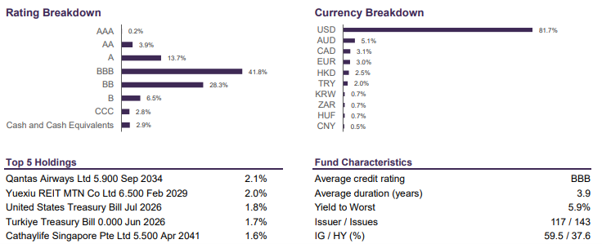
Fullerton Lux Funds – Flexible Credit Income invests across credit markets, including both investment-grade and high-yield bonds in USD and Asian currencies.
As of April 2026, the fund had a yield to worst5 of 5.9%, average duration of 3.9 years, and one-year return of 7.75%* for the Class A USD Dist share class.
*Calculated on a bid-bid single pricing basis in SGD with net dividends and distributions (if any) reinvested.
The fund’s broader credit exposure may offer higher income potential, but it also comes with higher credit and market risks compared with more conservative bond funds.
Fullerton Lux Funds – Flexible Credit Income – Class A (USD) Dist
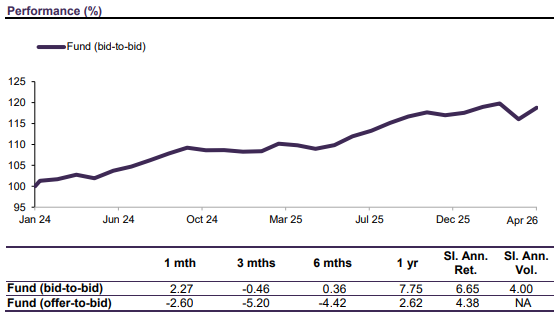
Returns of more than 1 year are annualised. Returns are calculated on a single pricing basis in USD with net dividends and distributions (if any) reinvested. Offer-to-bid returns include an assumed preliminary charge of 5% which may or may not be charged to investors. Past performance is not indicative of future returns. Source: Fullerton Fund Management Company Ltd.
What to watch out for?
Bond funds are not capital guaranteed, so their value can fluctuate.
Returns may be affected by various factors including changes in interest rates, credit events, or currency movements. This is why active management is critical in navigating the constantly evolving landscape, notably also amid shifting rate expectations at play presently.
Shorter-duration funds may help reduce sensitivity to rate volatility, while actively managed funds can adjust their positioning to be appropriately positioned, as market conditions change.
Why bonds matter?
Bond funds can help investors step up from cash, generate potential income, or access credit opportunities. They also play a crucial role in adding diversification, and potentially cushioning volatility to one’s broader investment portfolio.
The key is in choosing bond funds that matches your risk appetite, time horizon, income needs, and return objectives.
Explore Fullerton’s range of fixed income solutions at: https://www.fullertonfund.com/investment-capabilities/fixed-income/
Please refer to the Fund’s prospectuses for the full list of risk disclosures.
1 Yield to Worst (YTW): Refers to YTW in base currency taking into account the hedging cost. Not guaranteed. Past performance is not necessarily indicative of future performance.
2 Except for a 5% frictional currency limit to account for possible deviations from a 100% hedge.
3,4,5 Yield to Worst (YTW): Refers to YTW in base currency. Not guaranteed. Past performance is not necessarily indicative of future performance.
Important Information:
This publication is for information only and your specific investment objectives, financial situation and needs are not considered here. The value of units in the Fund and any accruing income from the units may fall or rise. Any past performance, prediction or forecast is not indicative of future or likely performance. Any past payout yields and payments are not indicative of future payout yields and payments. Distributions (if any) may be declared at the absolute discretion of Fullerton Fund Management Company Ltd (UEN: 200312672W) (“Fullerton”) and are not guaranteed. Distribution may be declared out of income and/or capital of the Fund, in accordance with the prospectus. Where distributions (if any) are declared in accordance with the prospectus, this may result in an immediate reduction of the net asset value per unit in the Fund. Applications must be made on the application form accompanying the prospectus, which can be obtained from Fullerton or its approved distributors. You should read the prospectus and seek advice from a financial adviser before investing. If you choose not to seek advice, you should consider whether the Fund is suitable for you. The Fund may use or invest in financial derivative instruments. Please refer to the prospectus of the Fund for more information.
This advertisement or publication has not been reviewed by the Monetary Authority of Singapore.