
Singapore has reached another milestone, celebrating 61 years of independence at a time when the global economic outlook remains uncertain.
Back home, the domestic economy continues to show resilience. Singapore’s GDP grew 5.9% year-on-year in the second quarter of 2026, following 6.3% growth in the first quarter, as per the Ministry of Trade and Industry’s data releases.
Inflation has also remained relatively contained while Singapore’s labour market continued to expand, with total employment growing for the 18th consecutive quarter1.
Meanwhile, mean gross monthly income from employment among employed residents rose 5.0% year-on-year in nominal terms in 1Q 20262.
Figure 1: Quarterly total employment change (excluding MDW) – in thousands
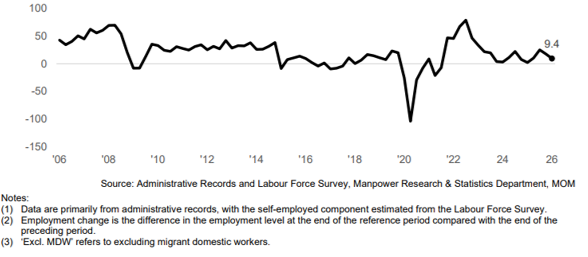
Source: Ministry of Manpower, 15 June 2026.
The Singapore dollar has also remained resilient throughout these global economic uncertainties.
Singapore’s combination of economic resilience, institutional strength, income generation attributes, opportunities for capital appreciation, and a developed financial market provides a unique proposition for investors.
Why does Singapore stands out for investors?
One of Singapore’s distinguishing features for investors is that it offers many sources of potential returns – ranging from income generation to capital appreciation.
At the foundation of Singapore’s fixed income market is its government bond market, one of the few AAA-rated government bond markets in the world by S&P3. It acts as an anchor for the broader SGD-denominated bond market, which gives investors access to a range of high-quality bonds and the potential for relatively stable income over the long term. The Singapore stock market also offers access to mature and established cash-generative listed companies with a track record of returning capital to shareholders for dividend income, while offering opportunities for growth.
This wide variety of capital market instruments provides multiple avenues to access and participate in Singapore’s investment proposition via a broader investing framework based on stability, income and growth.
#1 – Fullerton Short Term Interest Rate Fund: for potential stability
Some investors may want to keep part of their portfolio relatively conservative while waiting for greater clarity on interest rates, or general market direction.
This is where short-duration fixed income funds can potentially have a role to play.
The Fullerton Short Term Interest Rate Fund sits towards the more conservative end of Fullerton’s product range. With an average duration of around two years (as of end June 2026), its portfolio is generally less sensitive to interest-rate movements than longer-duration bond strategies, which can potentially help limit fluctuations when rates change.
The Fund invests primarily in fixed income securities and money market instruments, predominantly in Singapore. The portfolio’s foreign currency-denominated bonds are also fully hedged back to SGD (subject to a 5% frictional currency limit).
As of June 2026, the Fund held around 170 securities, with an average credit rating of BBB4 and an average coupon of about 4%.
Figure 2: Fullerton Short Term Interest Rate Fund performance
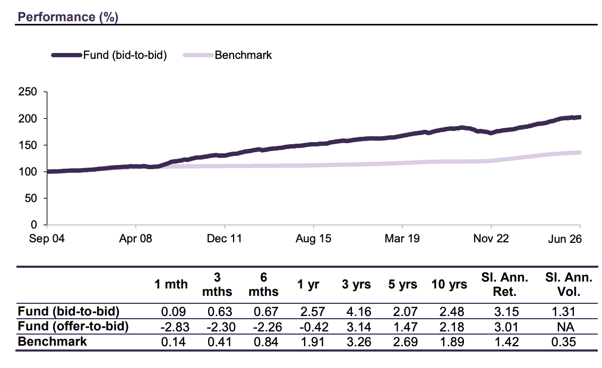
Source: Fullerton Short Term Interest Rate Fund Factsheet (Class A SGD) June 2026. Returns of more than 1 year are annualised. Returns are calculated on a single pricing basis in SGD with net dividends and distributions (if any) reinvested. Offer-to-bid returns include an assumed preliminary charge of 3% which may or may not be charged to investors. Benchmark: 3M SORA + 0.60% p.a. With effect from 1 August 2023, the benchmark is 3M SORA + 0.60% p.a. From inception till 31 July 2023, the benchmark was 3M SIBID.
The Fund recorded a 2.57% return over the past year and an annualised return of 4.16% p.a. over three years, on a bid-to-bid basis as of 30 June 2026. This compares with benchmark returns of 1.91% and 3.26% p.a. respectively over the same periods.
For investors who are awaiting greater market clarity, the Fullerton Short Term Interest Rate Fund offers a possible way to put their money to work while maintaining a relatively conservative fixed income allocation.
#2 – Fullerton SGD Income Fund: building an SGD income allocation
For investors looking for a broadly diversified fixed income fund and seeking medium-term capital appreciation, the Fullerton SGD Income Fund offers a potential avenue to build further on their income generation and SGD-focused fixed income allocations.
This Fund invests in a diversified portfolio of primarily investment grade bonds5. These include SGD-denominated securities as well as foreign currency-denominated bonds, which are fully hedged back to SGD (except for a 5% frictional currency limit).
It can also invest up to 30% of its NAV in non investment- grade bonds6, giving the Fund additional flexibility to seek income opportunities while maintaining a primarily investment grade mandate
Compared with the Fullerton Short Term Interest Rate Fund, the Fullerton SGD Income Fund has a longer duration and is therefore more sensitive to changes in interest rates. As of 30 June 2026, the Fund had an average duration of 4.4 years, an average credit rating of BBB7 and 222 holdings, with a yield to worst of 3.2% after hedging.
This longer duration profile means the Fund’s value may fluctuate more when interest rate expectations evolve, although it also provides potentially greater upside to bond price movements when yields fall.
Figure 2: Fullerton SGD Income Fund performance
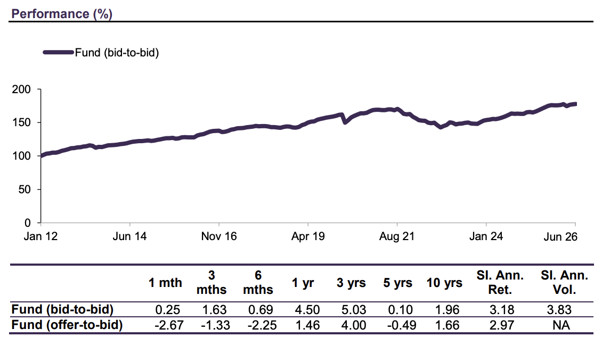
Source: Fullerton SGD Income Fund Factsheet (Class A SGD) June 2026. Returns of more than 1 year are annualised. Returns are calculated on a single pricing basis in SGD with net dividends and distributions (if any) reinvested. Offer-to-bid returns include an assumed preliminary charge of 3% which may or may not be charged to investors
As of 30 June 2026, the Fund had returned 4.50% over one year and 5.03% p.a. over three years on a bid-to-bid basis.
The Fullerton SGD Income Fund offers investors a core fixed income proposition with a greater emphasis on income generation, while taking on greater interest rate and credit risk compared to the Fullerton Short Term Interest Rate Fund.
Separately, for higher risk appetite investors who wish to further participate in Singapore’s growth narrative, equity-oriented solutions may be the more apt avenue. For this, there is Fullerton Singapore Value-Up.
#3 – Fullerton Singapore Value-Up: participate in Singapore’s next growth phase
Singapore’s next phase of equity market growth may lie in identifying companies where better capital allocation decisions and value-unlocking initiatives from management could strengthen shareholder returns.
Fullerton Singapore Value-Up identifies Singapore-listed companies with the potential to strengthen shareholder value through measures such as restructuring, improved corporate governance, more efficient capital allocation and stronger profitability. It looks for names that prioritise growth and shareholder value creation.
Fullerton’s strategy focuses on companies that are undergoing, or have the potential to undergo, such transformations. The investment team also engages with investee companies to encourage actions that can improve their business models and enhance shareholder value over time.
The Fund invests in SGX-listed securities and can invest across large, mid and small market capitalisation companies. It is managed as a high-conviction portfolio of around 20 to 40 stocks8, with the flexibility to look beyond the largest names on the Singapore Exchange.
This is relevant because opportunities in Singapore are not limited to its largest companies. Smaller and mid-cap companies may also offer overlooked and under-researched growth potential, particularly when restructuring, operational improvements, or better capital allocation may lead to stronger business performance and valuations.
This also ties in with the broader efforts to revitalise Singapore’s equity market, including initiatives by the Singapore government and the Monetary Authority of Singapore under its Equity Market Development Programme (EQDP).
As of end June 2026, Fullerton Singapore Value-Up had meaningful exposure to Singapore’s financial sector, with DBS Group Holdings and Oversea-Chinese Banking Corporation among its largest holdings9.
Singapore banks provide one example of how capital management can create value for shareholders. Strong capital positions have allowed the banks to return excess capital through measures such as special dividends, contributing to both income and capital returns for shareholders.
Fullerton Singapore Value-Up positioning
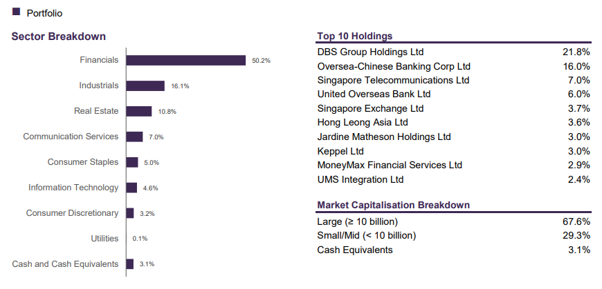
Source: Fullerton Singapore Value-Up Class A factsheet, June 2026.
The Fund is available in both distributing and accumulating share classes, thus catering to both investor types – those who are inclined to receive their dividends paid out in cash, as well as those who prefer for these to be automatically re-invested into the Fund.
Fullerton Singapore Value-Up performance
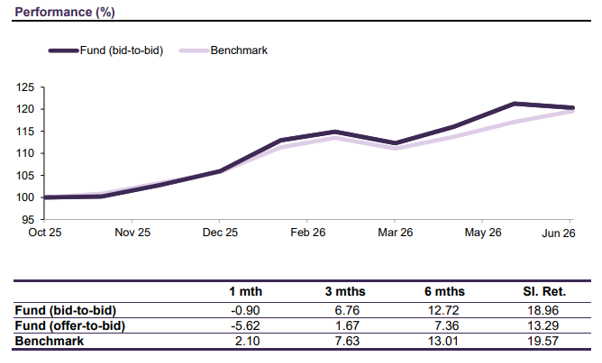
Source: Fullerton Singapore Value-up Factsheet (Class A SGD), June 2026. Returns of more than 1 year are annualised. Returns are calculated on a single pricing basis in SGD with net dividends and distributions (if any) reinvested. Offer-to-bid returns include an assumed preliminary charge of 5% which may or may not be charged to investors. Benchmark: FTSE Straits Times All Share Total Return Index.
As of 30 June 2026, Fullerton Singapore Value-Up Class A (SGD) returned 12.72% over six months and 18.96% since inception on a bid-to-bid basis.
Over the same periods, its benchmark returned 13.01% and 19.57%, respectively.
For investors seeking equity exposure to Singapore, Fullerton Singapore Value-Up potentially offers an avenue to participate in the potential longer-term growth of companies undergoing positive corporate transformation and value creation.
Complementary attributes of these three strategies
These three strategies illustrate the diverse and rich investment opportunities linked to Singapore.
The Fullerton Short Term Interest Rate Fund sits at the more conservative end, offering shorter duration fixed income exposure for investors seeking relatively greater stability while still putting their cash to work.
Fullerton SGD Income Fund on the other hand provides a core fixed income allocation, with a longer duration profile, and greater emphasis on potential income generation from a diversified bond portfolio.
Separately, Fullerton Singapore Value-Up provides the potential growth equity element – offering exposure to companies where positive corporate transformation and better capital allocation may support longer-term growth and shareholder value creation.
It is worth noting also that investors do not need to be exposed to these strategies in isolation as standalone solutions. They could access these strategies holistically – from income to growth opportunities via a diversified portfolio.
Together, these three strategies offer complementary ways to participate in Singapore’s investment market across stability, income and growth propositions, where investors can have mixed exposure to all.
How investors allocate between them will depend on factors such as their return objectives, risk tolerance levels, and also by assessing the role each strategy plays within the context of their larger, diversified portfolio.
What to watch out for10
Singapore’s relative stability does not mean that it can avoid investment risk.
Singapore equities remain exposed to global economic growth, trade conditions, interest rate changes and fluctuations in market sentiment. A locally listed company can still generate a significant portion of its revenue overseas, meaning global developments can affect its earnings and valuation.
Bond funds are also not capital guaranteed. Bond prices can fall when interest rates rise, with longer-duration funds generally more sensitive to these moves. Issuers can also face financial stress or re-payment difficulties.
Income should not be viewed as guaranteed either. Fund distributions may change over time and may be declared from income and/or capital, depending on the fund and share class.
The key is to understand how duration, credit quality, currency exposure and investment horizons differ across strategies before considering how each might fit within a portfolio.
Bottom line
At 61, Singapore’s investment appeal may increasingly be about resilience and income rather than purely just headline growth.
The country has continued to demonstrate economic resilience, with strong growth in the first half of 2026, manageable inflation, a resilient labour market, and a Singapore dollar that remains supported by MAS’ exchange-rate policy framework.
For investors who want part of their portfolios anchored in Singapore and SGD assets, this creates several possible sources of return.
Equities can provide participation in longer-term growth and corporate value creation.
Short duration fixed income can provide a more conservative way to put money to work while waiting for opportunities.
Separately, longer duration income strategies can provide exposure to a diversified bond portfolio with the potential for higher recurring income over time.
The opportunity, therefore, may not be about choosing between Singapore equities or bonds, but a diversified allocation to various approaches.
It is about recognising that each strategy can play a complementary role in a portfolio built around stability, income and growth, in a country where resilience is at the very core of its foundation.
Explore Fullerton’s wider range of solutions at: https://www.fullertonfund.com/investment-funds/featured-funds/.
1 Source: Singapore Ministry of Manpower (MOM) Labour Market Report Q1 2026, finalised on 15 June 2026.
2 Source: Singapore Ministry of Manpower (MOM) Income Summary Table, May 2026.
3 Source: https://www.worldgovernmentbonds.com/world-credit-ratings/, September 2026.
4,7 Where the security is not rated by external rating agencies, Fullerton’s internal rating methodology will apply.
5 Debt securities with relatively strong creditworthiness, and rated BBB or higher by S&P; or rated Baa or higher by Moody’s.
6 Debt securities with relatively weaker creditworthiness, and rated below BBB by S&P; or rated below Baa by Moody’s.
8 Number of stocks in the portfolio is subject to changes without further notice.
9 References to specific securities are for illustration purpose only and does not represent Fullerton’s current view of the security or constitute any recommendation.
10 Please refer to the respective fund’s prospectuses for the full list of risk disclosures.
Publication date: September 2026.
Important Information:
This publication is for information only and your specific investment objectives, financial situation and needs are not considered here. The value of units in the Fund and any accruing income from the units may fall or rise. Any past performance, prediction or forecast is not indicative of future or likely performance. Any past payout yields and payments are not indicative of future payout yields and payments. Distributions (if any) may be declared at the absolute discretion of Fullerton Fund Management Company Ltd (UEN: 200312672W) (“Fullerton”) and are not guaranteed.
Distribution may be declared out of income and/or capital of the Fund, in accordance with the prospectus. Where distributions (if any) are declared in accordance with the prospectus, this may result in an immediate reduction of the net asset value per unit in the Fund. Applications must be made on the application form accompanying the prospectus, which can be obtained from Fullerton or its approved distributors. You should read the prospectus and seek advice from a financial adviser before investing. If you choose not to seek advice, you should consider whether the Fund is suitable for you. The Fund may use or invest in financial derivative instruments. Please refer to the prospectus of the Fund for more information.
This advertisement or publication has not been reviewed by the Monetary Authority of Singapore.