
Volatility has returned to global markets. After a short reprieve, markets are facing headwinds again with questions around the monetisation benefit payoffs from large AI CAPEX spends and renewed geopolitical tensions in the Middle East.
This can make it tempting for investors to wait on the sidelines. Yet for investors, the more pressing issue is not whether markets will remain choppy in the near term, but whether structural long-term opportunities are still being created beneath the noise, and where to find and access them.
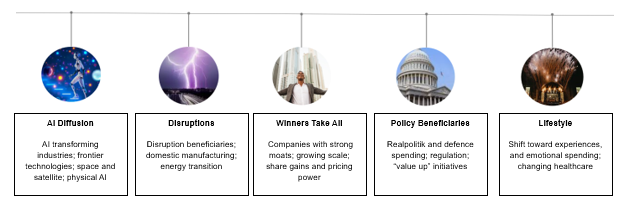
Fullerton’s view is that while equity returns may be normalising after a very strong run, the underlying earnings backdrop remains resilient, and several long-term alpha enablers are still firmly in place. We have identified five of such key alpha sources – as depicted in Figure 1 below.
Figure 1: Fullerton’s anchor investment themes and potential sources of alpha
Source: Fullerton Fund Management, July 2026. Investment themes are developed from our internal methodology and are subject to change.
A more volatile market does not necessarily mean a weaker long-term case for equities. Instead, it often means that as dispersion rises, leadership narrows, and as geographical and sectoral performance become more differentiated, active management and the ability to be more nimbly positioned, becomes more important. Fullerton’s view is that investors need to “Stay calm and carry on, with discipline”, because tighter liquidity, de-rating pressures and uneven performance across regions are likely to make stock selection increasingly critical in driving performance.
For example, in tech the “first wave of advance” from the AI theme may be maturing. The beneficiaries and even those adversely impacted from AI are disproportionate – gains are broadening away from the chipmakers to related industries such as the neocloud players, the “pick and shovel” component manufacturers to AI data centres along the supply chain, as well as to power suppliers – that are benefitting from the huge demand for AI data processing and computing power, or even server cooler manufacturers. Conversely, other sub-sectors in tech like the Software as a Service (Saas) players may be increasingly under pressure with AI being able to automate many of their services. The key here is that there is diffusion in the AI space and investors need to be discerning.
Beyond “AI Diffusion”, we see other long-term structural opportunities coming to the fore from “Disruptions” like – energy transition and manufacturing re-onshoring; creative monopolies that may emerge with increased market share in a “Winners Take All” world; “Policy Beneficiaries”, as well as shifts in consumption habits linked to “Lifestyle” changes.
We elaborate more on these themes below.
One of the clearest long-term structural themes remains frontier technology and the continued diffusion of AI. The impact of AI and related technologies is broadening – with the potential to raise productivity, lower costs and support earnings growth across the real economy. But the investment implication is more nuanced than simply buying “AI winners” or chipmakers. We have consistently emphasised this balancing act: while AI can create productivity gains and earnings tailwinds in sectors such as IT, healthcare and financials, it can also disrupt incumbent business models and create demand destruction elsewhere. That is precisely why active stock selection remains crucial, because not everything associated with AI or technology will necessarily deliver sustainable returns.
A second structural opportunity lies in “Disruptions” – not disruptive upheaval for its own sake, but transformative forces and change that re-shapes value chains, re-distributes margins and creates new victors. Our framework points to “Disruption” beneficiaries in areas such as domestic manufacturing (from re-onshoring trends) and the energy transition, where capital spending, supply-chain re-wiring and new policy priorities are altering the competitive dynamics. The most productive countries, and businesses that are most adaptable to changing supply-chain and energy structures, are better placed to navigate a volatile and disruptive environment.
For active investors, this matters because disruption rarely lifts all participants equally. It tends to reward readily positioned businesses with the technology, balance-sheet strength and execution capability that can adapt quickly, while leaving weaker incumbents exposed to pricing pressure, stranded assets or slower growth. It is therefore incumbent on active managers to identify the winners and losers.
This dovetails neatly to the third, “Winners Take All” theme – the notion that industry leaders with scale, pricing power, intellectual property or structural advantages can continue to sustain its advantage and pull away from the weaker peers. This is especially relevant in a more demanding market where liquidity is tighter and investors are becoming more selective. In such an environment, broad market exposure may not deliver the desired returns, but differentiated outcomes are more likely to come from active selection – via a meticulous research-driven approach to owning the right businesses rather than passive investing.
The fourth structural opportunity lies in “Policy Beneficiaries”. Globally, fiscal and industrial policy are re-shaping corporate investment decisions, capital flows, and defence spending budgets. These forces will in turn, influence sector leadership for many industries. We are of the view that government spending remains significant across key markets including China, the US, Japan and Germany, and such policy support can provide an important impetus for investor confidence and equity market alpha. Additionally, government-led initiates and reforms such as Korea’s Corporate Value-Up Programme and Singapore’s Equity Market Development Programme are galvanising investor interest. We are also of the view that Germany’s sweeping pivot and constitutional reforms to its fiscal framework to spearhead productivity, may lead to beneficiaries in its industrials, financials, utilities and infrastructure-related sectors. These are areas that can be further explored.
The final structural theme in our framework is “Lifestyle” beneficiaries. Consumption preferences are shifting towards experiences (especially tourism), convenience, wellbeing and more emotionally resonant spending. At the same time, healthcare demand is also changing as populations age and as consumers place greater emphasis on quality of life, prevention and personalised care. For global equity investors, this opens opportunities across selected consumer and healthcare names that meet such consumer demands, and businesses who can capture durable demand rather than models that rely on cyclical spending.
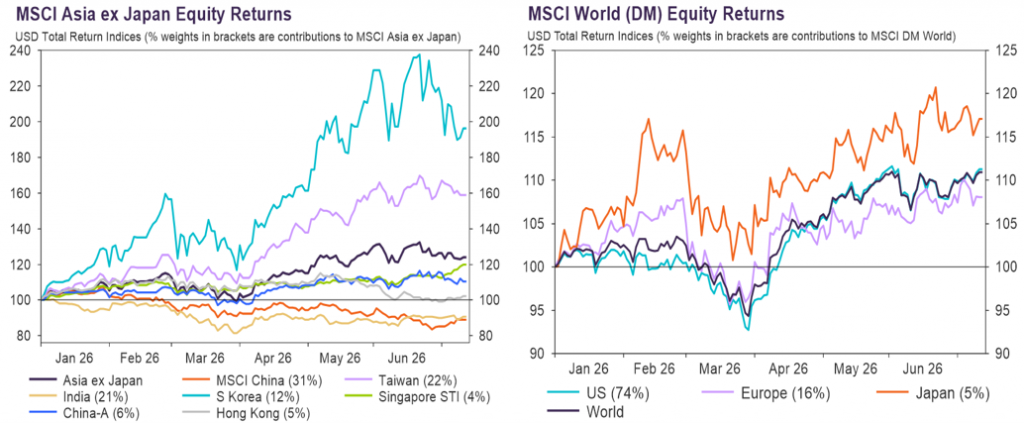
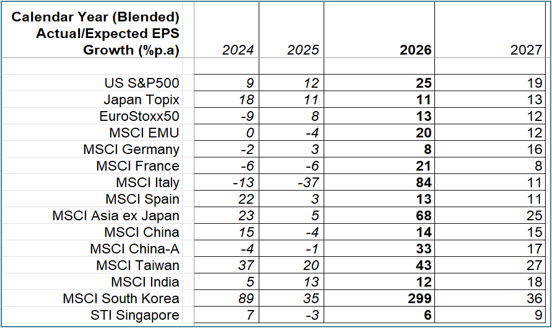
Today’s market backdrop reinforces the need to focus on the longer-term structural return drivers (with sustained growth runway ahead) and selectivity. We are of the view that equity markets have rallied strongly over the past two years and may now be transitioning towards more normal return patterns. Some markets are still supported by robust earnings, but sources of alpha have narrowed and there is a growing need to distinguish between durable winners and areas where expectations may already be too optimistic. For active managers, this is an opportunity where stock selection can play a larger role in impacting realised portfolio returns.
Figure 2: Equity returns have rallied hard and may now be transitioning toward normality over time
Source: LSEG Datastream, July 2026.
Figure 3: Earnings performance and its expectations are exceptionally strong for 2026, but significant slowing toward normalisation is anticipated for 2027
Source: LSEG Datastream, July 2026
When navigating uncertainty, this is where the case for Fullerton Lux Funds – Global Absolute Alpha becomes particularly relevant. The fund is an unconstrained, long-only global equity portfolio of 30 to 50 1 high-conviction names, where stock selection is a key alpha driver. The fund’s investment process is overlaid with top-down macro analysis, and dynamic risk management. In other words, it is designed not simply to own global equities, but to actively navigate market cycles through stock selections.
The fund is a long-only portfolio of our best ideas, and we actively use cash to preserve capital during periods of market downturn. This framework is important in today’s conditions. Volatility can create sharp reversals, where portfolios that are overly reactive may miss the meaningful recoveries that matter most for long-term compounding.
Our current view also is that tighter spare liquidity for investing, return normalisation and geopolitical shocks can all create periods of volatility and undershooting in markets. Nonetheless, the conclusion is not to abandon equities. Rather, it is to remain invested with discipline, focusing on businesses aligned to durable structural trends and supported by active, research-led portfolio construction, as is the case with Fullerton Lux Funds – Global Absolute Alpha.
Market volatility can be acute, but it can also obscure the fact that some of the most important long-term drivers of global equity returns further out, are still intact: AI Diffusion; Disruptions – from re-onshoring and energy transition trends; the emergence of dominant corporate winners across regions and sectors in a “Winers Take All’ world; policy beneficiary-led investments; and consumption-related ideas from Lifestyle-related shifts are some of the longer-term opportunities we see.
In that context, Fullerton Lux Funds – Global Absolute Alpha offers a possible avenue to stay invested in global equities with an active approach that seeks to identify selected structural opportunities and manage the journey through market cycles.
1 Internal guidelines and subject to change without prior notice.
Important Information:
This publication is for information only and your specific investment objectives, financial situation and needs are not considered here. The value of units in the Fund and any accruing income from the units may fall or rise. Any past performance, prediction or forecast is not indicative of future or likely performance. Any past payout yields and payments are not indicative of future payout yields and payments. Distributions (if any) may be declared at the absolute discretion of Fullerton Fund Management Company Ltd (UEN: 200312672W) (“Fullerton”) and are not guaranteed. Distribution may be declared out of income and/or capital of the Fund, in accordance with the prospectus. Where distributions (if any) are declared in accordance with the prospectus, this may result in an immediate reduction of the net asset value per unit in the Fund. Applications must be made on the application form accompanying the prospectus, which can be obtained from Fullerton or its approved distributors. You should read the prospectus and seek advice from a financial adviser before investing. If you choose not to seek advice, you should consider whether the Fund is suitable for you. The Fund may use or invest in financial derivative instruments. Please refer to the prospectus of the Fund for more information.
Source: MSCI. Neither MSCI nor any other party involved in or related to compiling, computing or creating the MSCI data makes any express or implied warranties or representations with respect to such data (or the results to be obtained by the use thereof), and all such parties hereby expressly disclaim all warranties of originality, accuracy, completeness, merchantability or fitness for a particular purpose with respect to any of such data. Without limiting any of the foregoing, in no event shall MSCI, any of its affiliates or any third party involved in or related to compiling, computing or creating the data have any liability for any direct, indirect, special, punitive, consequential or any other damages (including lost profits) even if notified of the possibility of such damages. No further distribution or dissemination of the MSCI data is permitted without MSCI’s express written consent.
This advertisement or publication has not been reviewed by the Monetary Authority of Singapore.